
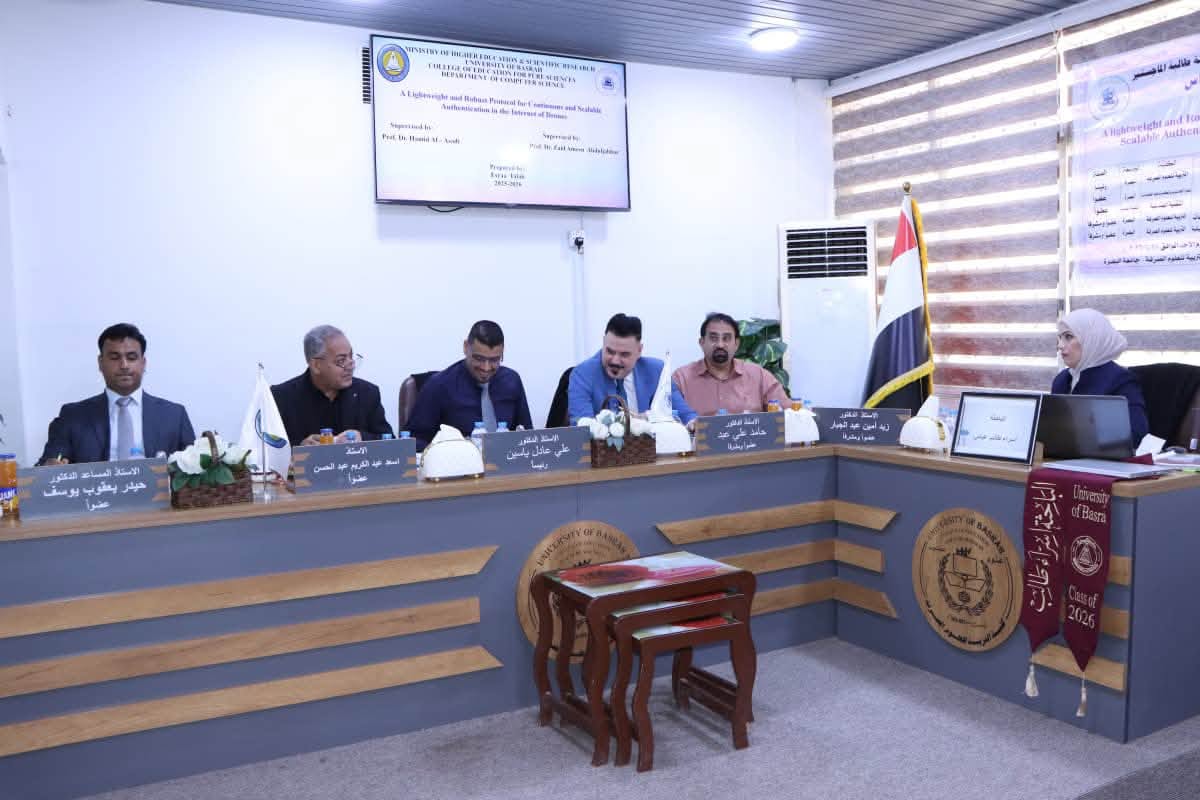
The College of Education for Pure Sciences, Department of Computer Science, reviewed a master's thesis on "A Lightweight and Robust Protocol for Continuous and Scalable Authentication in Drone Internet." The thesis, submitted by researcher Israa Talib Abbas, aimed to address the following: Drones enable the collection and processing of data remotely in real time via various wireless technologies. Consequently, they have found applications in numerous fields, such as wildlife monitoring, emergency response, pipeline inspection, military surveillance, traffic management, search and rescue, and agriculture. However, communication between drones occurs via public and open radio channels, exposing data exchange to numerous security and privacy threats, such as unauthorized access by authorized personnel, communication rebooting, interception, session key disclosure, and identity theft. To counter these threats, several security protocols have been developed. However, achieving complete security while minimizing computing, energy, and communication costs remains a challenge. Implementing authentication procedures is one way to achieve this goal, involving verifying the identity of network participants using smart devices and authenticating drones. This will enhance the confidentiality and security of data transmitted between entities, thereby strengthening the security of the Internet of Things against cyberattacks.
The thesis included:
A study of the fundamentals of lightweight cryptography to develop a protocol with proven resilience. Formal security analysis using Scyther, Proverif, and Burrows-Abadi-Needham (BAN) logic confirms the robustness of the implemented shared authentication procedures. Furthermore, semantic security analyses demonstrate its ability to protect against attacks such as drone hijacking, synchronization loss, validator theft, impersonation, and message retransmission. Moreover, performance evaluation shows that our system requires minimal energy and computational resources, with relatively low connectivity costs. The high efficiency of the proposed protocol means it is highly scalable and can therefore efficiently support an increasing number of drones within the network. It also supports uninterrupted authentication due to its low computational costs. Moreover, comparative performance evaluations demonstrate the efficiency of its computational, connectivity, and energy costs. In the proposed work, efficient results were achieved for our system's computation costs, which are 1.7088 milliseconds, a connection cost of 2016 bits, and a power consumption of 9.1397 millijoules. The proposed protocol improves available functionality by 35.29%. This means that the proposed protocol is the most reliable for IoT applications compared to previous protocols
 .
.
Important News



viewed most