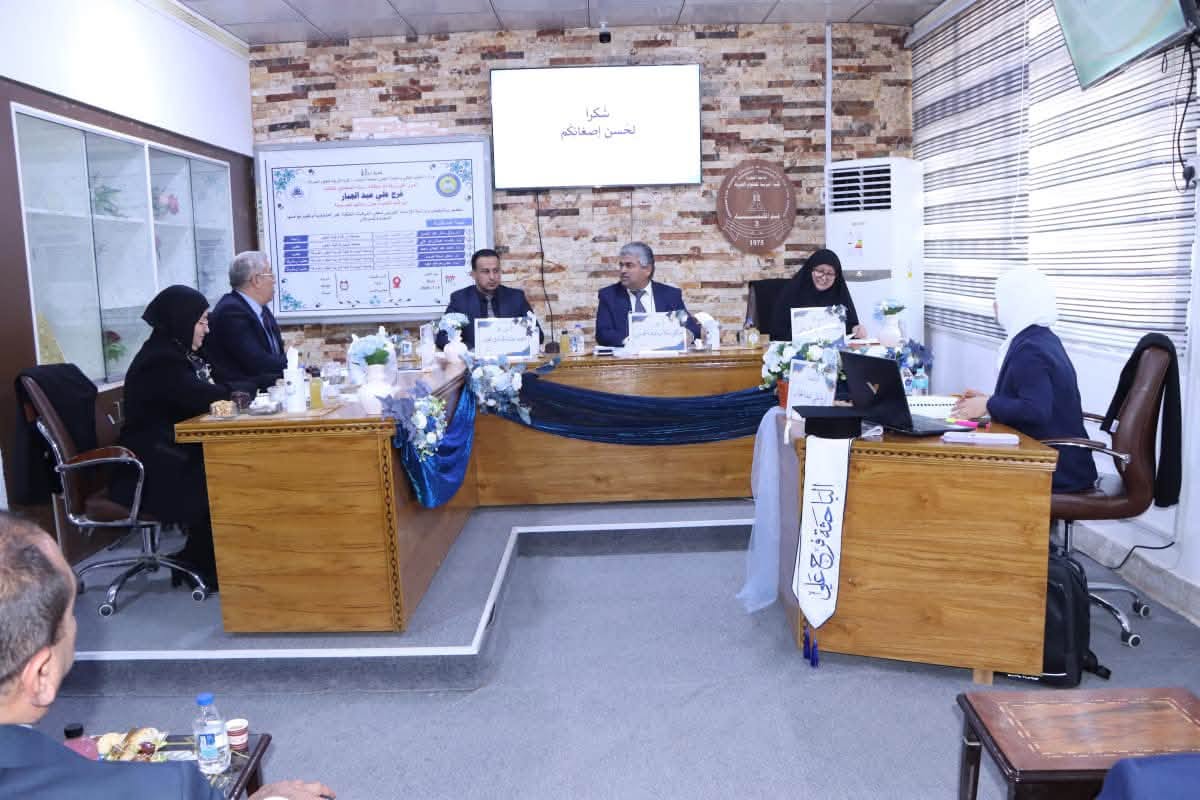
The College of Education for Pure Sciences, Department of Chemistry, reviewed a master's thesis on (Preparation, Characterization, and Molecular Docking of Some Heterocyclic Compounds and Evaluation of Their Anticancer Properties). The thesis, submitted by researcher Farah Ali Abdul Jabbar, aimed to investigate eight heterocyclic Schiff bases derived from 2-aminobenzothiazole, 6-methoxy-2-aminobenzothiazole, and 6-ethoxy-2-aminobenzothiazole with several aromatic aldehydes. The resulting cyclic compounds were characterized spectroscopically to confirm their proposed chemical structures using mass spectrometry, infrared spectroscopy (IR), and proton and carbon-13 nuclear magnetic resonance (NMR). Furthermore, molecular docking studies were conducted on the prepared heterocyclic Schiff bases to determine their molecular docking potential and subsequently evaluate their ligand binding to active sites on several protein receptors targeted by breast cancer. Specifically, aromatase inhibitor receptors (PDB ID: 5JL6) and (PDB ID: 5JL7).
Cytotoxicity measurements were performed on the prepared heterocyclic Schiff bases F8-F1. Cytotoxicity tests using the MTT method demonstrated the high efficacy of the prepared compounds in inhibiting the growth of MCF-7 breast cancer cells.
The MTT assay was also used to measure cellular metabolic activity as an indicator of cell viability and cytotoxicity. It was observed that the assay darkened with increasing numbers of metabolically active, viable cells. IC50 values were calculated for compounds F8-F1 and cisplatin. All the prepared Schiff bases showed significant inhibition of MCF-7 breast cancer cell growth, albeit at relatively low values. Compound F8 exhibited an IC50 value of 28.5 μM against MCF-7 breast cancer cells, which was very close to that of platinum sulfate (27.0 μM). This indicates that compound F8 is highly effective in inhibiting the growth of MCF-7 breast cancer cells. Furthermore, compounds F5 and F4 were not as effective in inhibiting the growth of breast cancer cells tested using the MTT method.
These experimental cytotoxicity measurements are consistent with the theoretical study and molecular docking results, which showed the same sequence of activity based on binding energies, the number of hydrogen bonds formed, and other interactions.
Based on these promising theoretical and experimental cytotoxicity results, compound F8 can be considered a promising candidate for inhibiting breast cancer cells
 .
.
Important News



viewed most