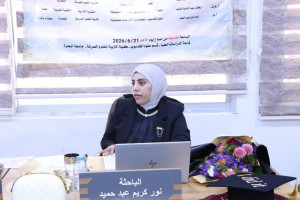
The College of Education for Pure Sciences, Department of Computer Science, reviewed a master's thesis on "Malware Detection Using Artificial Intelligence Algorithms." The thesis, submitted by researcher Mustafa Qanbar Juma, addressed the significant security challenge posed by malware targeting Internet of Things (IoT) devices. This is due to the diverse range of malware, including memory-based, hidden, and aggressive types that evade traditional detection methods. Early detection of malware allows for rapid threat mitigation, minimizing its impact on affected systems, reducing service downtime, and ensuring overall service security.
This thesis presents a comprehensive and aggressive malware detection system utilizing preprocessing, feature selection, aggressive training, and deep learning techniques. The CIC-MalMem-2022 dataset, containing samples of malware such as ransomware, Trojans, spyware, and benign malware, was used.
The data was preprocessed through cleaning or encryption. To address class imbalances, SMOTE technology was employed. To address computational complexity challenges, the feature vector dimensions were reduced to 18 using XGBoost and MI. A hybrid CNN-LSTM-Attention model was deployed to capture spatial, temporal, and contextual dependencies.
The model achieved 99.97% accuracy before applying hostile training. After adding hostile samples using FGSM, our model's accuracy remained at 99.96%. Furthermore, the recall rate, F1 score, and AUC reached 99.98%, 99.96%, and 1.0, respectively. Thus, the proposed model exhibits a low error rate on benign samples.
The average inference time is 0.29 ms per sample, and resource utilization is moderate, facilitating the model's deployment in a real-time IoT environment. A user interface was developed to extract behavioral features and obtain real-time memory snapshots evaluated using the trained model. This interface supports interactive results display and the export of reports to CSV files for readable interpretation
 .
.
Important News

viewed most